Guides · updated 9 October 2026
How to read a Japanese auction sheet: grades, damage codes and inspector notes
A Japanese auction sheet is one page written by the auction house’s inspector. The overall grade runs from S down to 1, with R for repaired accident damage. The body diagram carries codes like A1 (small scratch), U2 (dent), W (panel work) and XX (replaced panel). The notes box says what the codes cannot. Below, each part in turn, using the published USS rules and a real sheet from our sample.
A real sheet, decoded
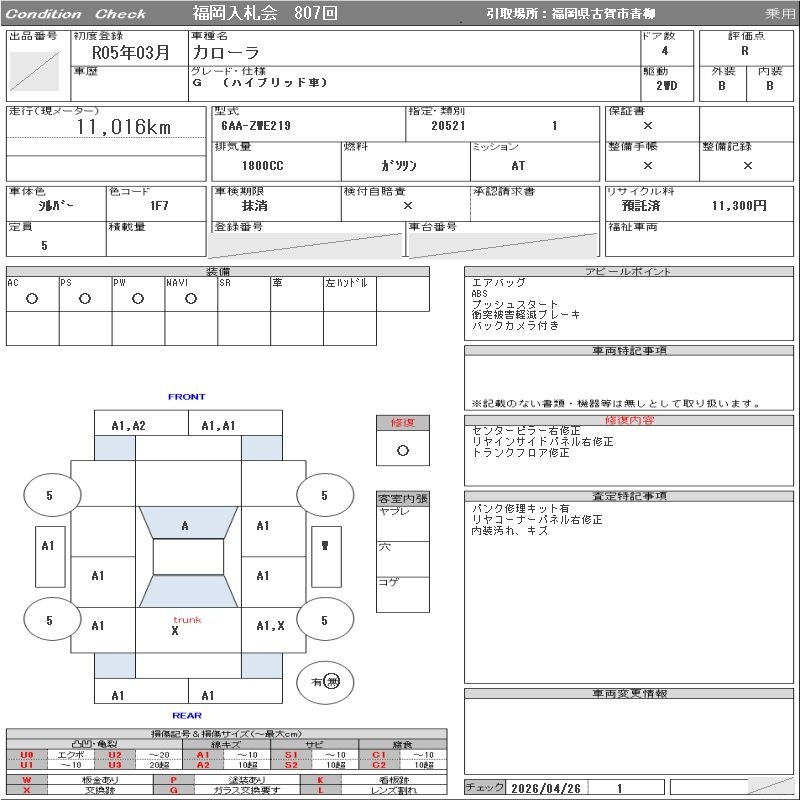
Read it top to bottom. The header gives the auction (Fukuoka) and the car: first registered R05年03月, which is March 2023, model code 6AA-ZWE219, 1800 cc, automatic, silver. The odometer box says 11,016 km. On the right, the overall grade is R, exterior B, interior B.
That R is the story. The repair box is ticked, and the repair list reads: right centre pillar corrected, right rear inside panel corrected, boot floor corrected. On the diagram the car is covered in A1 marks (small scratches), with X marks at the rear. The inspector’s notes add a puncture repair kit present, the right rear corner panel corrected, and dirt and scratches inside. The archive record shows it sold for ¥1,460,000. So: a clean-looking three-year-old hybrid with low mileage, and structural repairs down the right side and in the boot floor. The advert would not have said so.
Overall grade
This is the USS scale from its inspection rules. A car gets a grade only if it meets every condition in that row. Other houses and the AIS standard used by several dealer groups run close to it; the legend on the sheet says which scale applies.
| Grade | What USS requires |
|---|---|
| S | Under 10,000 km, no more than 12 months since first registration, interior A, almost no marks and no repairs |
| 6 | Under 30,000 km, no more than 36 months old, interior A, almost no marks, engine and suspension in good order |
| 5 | Under 50,000 km, interior A, small marks you have to look for, no exterior parts replaced |
| 4.5 | Under 100,000 km, interior B or better, reaches a 5 with light touch-up work |
| 4 | Under 150,000 km, interior C or better, some visible scratches, dents, rust or burns that need work |
| 3.5 | Interior D or better, several places that need panel work |
| 3 | Interior E: needs full repair, replacement or re-trimming |
| 2 | Low commercial value, badly corroded or otherwise poor cars |
| 1 | Flood damage, or a fire extinguisher discharged inside |
| R | Repair history: structural damage repaired (see below) |
| × | Hard to grade: very old cars, replicas, special vehicles |
What makes a car an R
Under the USS rules a car has repair history when its skeleton was damaged: the frame, cross members, inside panels, cowl panel or boot floor replaced or straightened, a pillar (other than its outer skin) replaced or straightened, a badly repaired roof, or the floor panel replaced or straightened. Bolt-on panels do not count. A car can have a new bumper and wing and still be a 4.
Interior grade
| A | No work needed, or only two or three small marks that clean off |
| B | Light work needed: a few tears, burns, scuffs or screw holes |
| C | Work needed, or faults that lower the value; dirty throughout |
| D | Major work needed: many burns or tears, a badly warped dashboard, heavy dirt |
| E | Major work throughout: big cracks, heavy stains, strong smell |
Damage codes on the body diagram
The letter says what, the number says how big. For dents and scratches, the legend at the bottom of our sample sheet sets 1 at up to about 10 cm and 2 at up to about 20 cm, with 3 for anything bigger. The Japan Auto Appraisal Institute uses coins and paper instead: 0 under a 500-yen coin, 1 under a card, 2 under an A4 sheet, 3 bigger than A4. Houses differ in detail, so the printed legend on your sheet wins.
| Code | Meaning |
|---|---|
| A | Scratch. A1 is small, A2 bigger, A3 larger still |
| U | Dent. U0 is a dimple, U1 small, U2 bigger, U3 larger |
| B | Dent with a scratch (some houses write UA) |
| E | Dimples, small dents in a group |
| W | Panel work or repaint. W1 is barely visible, W2 noticeable, W3 needs doing again |
| S | Rust |
| C | Corrosion |
| P | Paint: repainted, faded or peeling (houses differ) |
| X | Panel replaced, or needs replacing (check the legend on the sheet) |
| XX | Panel already replaced |
| G | Glass: chip, or glass needs replacing |
| Y or T | Crack or hole |
| K | Marks left by signage or stickers |
| L | Cracked lamp lens |
One code on its own means little. A pattern does: W and XX on a wing, door and pillar on the same side, next to an R grade, is a side impact that was put right.
The mileage box and its marks
The odometer figure is what the meter showed on the day. The USS listing rules add three marks to watch for: * for a car the seller declares as having a tampered meter (estimated real distance in the notes), $ for a replaced meter (the two readings added together), and # for unknown mileage. How to cross-check the figure is in Is the mileage real?
Inspector notes and the rest
The notes are handwritten or typed in Japanese: repaired panels, smells, warning lights, aftermarket parts, missing keys. They often matter more than the grade. The equipment line uses short codes (AC, PS for power steering, PW for power windows, NAVI, SR for sunroof), and there are boxes for the service book, the owner’s manual and the shaken expiry. On a car sold for export the shaken box often says cancelled, as on our sample.
Buying from a dealer who already imported the car? The sheet still exists. Put the chassis number from the export certificate or the car’s plate into the field below and compare what the dealer shows you with the original.
Check the sheet for your car
Auction appearances with dates and grades are free. The sheet itself opens for €9.99 incl. VAT.
Questions
What does grade R mean on a Japanese auction sheet?
A car with repair history. Under the USS inspection rules that means structural parts were damaged: the frame, cross members, inside panels, cowl panel or boot floor replaced or straightened, pillars (other than the outer skin) replaced or straightened, a badly repaired roof, or the floor panel replaced or straightened. A repaired bumper or door does not make a car R. The repair box on the sheet lists what was done.
What does A1 mean on an auction sheet?
A small scratch. A is the letter for scratch, and the number is the size. On the Fukuoka sheet in our sample, 1 means up to about 10 cm and 2 up to about 20 cm. The Japan Auto Appraisal Institute uses a similar scale based on a card and an A4 sheet. Always use the legend printed at the bottom of the sheet you are reading.
What does XX mean on an auction sheet?
The panel has been replaced. A single X can mean replaced or needs replacing, depending on the house: the Fukuoka sheet in our sample lists X as a replacement mark. Several XX panels on one side of the car usually go with an accident repair, so look at the grade and the repair box next.
Is grade 4 good for a Japanese import?
It is a fair, used car. Under the USS table a 4 has under 150,000 km, an interior grade of C or better, and some visible marks that need work. Grade 4.5 is under 100,000 km and needs only light touch-ups. Many buyers aim for 4 or better with no R.
What does a star or dollar sign next to the mileage mean?
Under the USS listing rules a * after the mileage marks a car the seller declares as having a tampered odometer, with the estimated real distance in the notes. A $ marks a replaced meter, with the combined distance written in. A # means the true mileage is unknown. Any of the three is a reason to stop and ask.
Can I get the sheet translated?
Yes. When you open a sheet on jdmsheet for €9.99, the damage map is decoded code by code, the inspector's notes and repair list are translated into English or the language you choose at checkout, and you get the odometer reading, sale price, equipment and photos. The codes are decoded by fixed rules, not guessed, and the document shows only the codes that appear on your sheet.
Sources
- USS inspection rules, grade table (Japanese, revised 1 October 2012)
- USS listing and bidding rules, odometer marks * $ # (Japanese, revised 1 October 2012)
- Japan Auto Appraisal Institute (JAAI): damage symbols and sizes (Japanese)
- ORIX U-car: how to read the grade (AIS standard, Japanese)
Checked 9 October 2026.